Showing posts with label Greek Orthodox. Show all posts

Monday, May 10, 2010

St. Chora's amazing High Definition mosaics

Ten megapixel Mosaics!


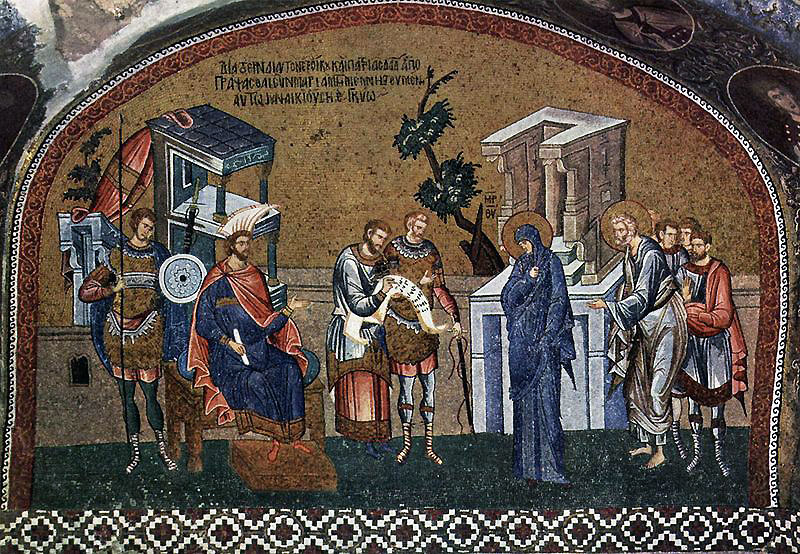
St. Chora Church is not the most impressive of the Byzantine churches but it has arguably the best mosaics of the era (10-12th century), all executed when the fate of Constantinople was very clear with the city surrounded by the Ottoman forces. The church is best known for housing some of the best preserved mosaics and frescoes from the late-Byzantine period and considered among the very best in the world. (Photo: Krikor Tersakian)
St. Chora High Definition mosaic: St. Paul at St. Chora church. Unsurpassed quality. 

It is funny, but every time I mention the Chora church to friends in Montreal, they think I am talking eggs, fruits and and pancakes ! You see, "Cora" is a pretty successful breakfast serving chain in Quebec owned by a Greek businesswoman, while I am trying to talk about the Chora church in Constantinople that houses the best Byzantine Mosaics and Frescoes, arguably the finest in the world!

The world had to wait until very recently for the introduction of High Definition TV and screens, but the incredible and unparalleled mosaics of St. Chora church were executed in "HD" in the 14th century! Some of the mosaic stones used are smaller than rice grains and the overall quality and execution are unparalleled. Mosaic is a very difficult art, and the Chora church is the ultimate temple of this lost but very noble Art.


St. Chora Church (known also as Kariye Museum) is a rather ordinary looking and medium sized church but amazingly it has some of the very best Byzantine mosaics of the 12-14 century to be found anywhere. Constantinople or Istanbul is long known as a city with layer upon layer of cultural riches and heritage dating from ancient times. But beyond all the obvious and universally acclaimed sites, St. Chora is a jewel that’s rarely seen or known. Therefore easily confused with the Montreal breakfast chain by some...


The Chora Church was originally built outside the defensive walls of Constantinople on the south of the Golden Horn, 4 Km west of  HaghiaSophia and Topkapi. The church's full name was the Church of the Holy Saviour in the Country (Greek ἡ Ἐκκλησία του Ἅγιου Σωτῆρος ἐν τῃ Χώρᾳ, hē Ekklēsia tou Hagiou Sōtēros en tē Chōra). The name, Chora referring to its location originally outside of the walls, became the shortened and accepted name of the church. The original church on this site was built in the early 5th century, and stood outside of the 4th century walls of Constantine the Great. However, when Theodosius II built his impregnable land walls in 413–414, the church became incorporated within the city's defenses, but retained the name Chora. The church became an important stopping point for Pilgrims on their way to the Holy Land.
Early in the 12th century, the church suffered a partial collapse, perhaps due to an earthquake and was rebuilt. However, it was only after the third phase of building, two centuries after, that the church as it stands today was completed.
Therefore the majority of the current building dates from 1077–1081, when Maria Ducaena, the mother-in-law of Alexius I Comnenus, rebuilt the Chora Church as an inscribed cross (quincunx), which was a popular architectural style of the time. Early in the 12th century, the church suffered a partial collapse, perhaps due to an earthquake. The church was rebuilt by Isaac Comnenus, Alexius's third son. However, it was only after the third phase of building, two centuries after, that the church as it stands today was completed.
  
The powerful Byzantine statesman Theodore Metochites endowed the church with much of its fine mosaics and frescoes. Theodore's impressive decoration of the interior was carried out between 1315 and 1321, thee mosaic-work being the finest example of the Palaeologus Renaissance. In 1328, Theodore was sent into exile by the Andronicus III but later was allowed to return and lived as a monk his last two years in the church.  Finally in 1453 The Ottoman occupied the city through a defensive lapse very near the St. Chora church at Edirne Kapi. The Byzantine soldiers knew their surrounded city was doomed and were resting, praying and finding solace at the Chora.

After theOttoman conquest under the Sultan Fatih, this unique church Around became a mosque. Fifty years after the fall of Constantinople to the Ottomans (in 1453), Atık Ali Paşa, the grand vizier of Sultan Bayazid II, ordered the Chora Church be converted into a mosque — Kariye Camii. Due to the prohibition against images in Islam, the mosaics and frescoes were mostly left unharmed but were covered behind layers of plaster. This and frequent earthquakes in the region had taken their toll on the artwork until their restoration. Another earthquake in 1894 did not help either.

In 1948 the scholar Thomas Whittemore (Dumborton Oaks Byzantine Institute, Washington D.C.) who had done restoration work at the Haghia Sofia, sponsored also a audacious program of restoration of the unique art at the Chora, removing the plaster and restoring the artwork to its splendor. Awesome mosaics and frescoes were discovered, unique in their fine detail, displaying very subtle shadings and very rich colors that are unknown or lacking in earlier Byzantine mosaics. From that time on, the Chora church ceased to be a functioning mosque. In 1958, it was opened to the public as a museum — Kariye Müzesi. In today's Istanbul, St. ChoraHaghia Sofia in the pecking order. Still, it is a must see of universal importance.

A Brief history of the lost art of the mosaics 


It is very difficult to elaborate about the exacts origins of the mosaic art as various civilizations from Mesopotamia to Rome have somehow excelled in their own right and not always in religious themes. Purely decorative mosaics with geometrical patterns were also mastered along with the mythological characters, saints, earthly or heavenly scenes etc. Early christians adopted mosaics fast and made them an integral part of church decorations. Mosaics were indeed extensively used both the secular dwellings as well as religious buildings throughout the Roman Empire and the Mediterranean basin.

Despite all this, it is safe to argue that mosaics were most popular in the Eastern Roman Empire and hence were perfected by the Byzantines and therefore the Orthodox Christian rites. Others, such as Venice and other Italian cities also mastered the art as they were in constant friendly (and not so friendly) contact with Byzantium. The mosaics were an ancient roman tradition but in my view they reached their perfection under the Byzantines as witnessed in the St. Chora and a few churches and monasteries. 


Mosaic is described as an art where the collage of small pieces of glasses, glazed clays, shells, pebbles, stones and even semi precious stones are used to create a decoration (images, landscapes, religious scenes, geometrical patterns etc.). The stones or glasses are cut to different shapes and the multicolor assemblage is used to create the final work "in situ" (on site, that is in a palace, cathedral, monastery etc).  The glasses of different colors are referred to as tesserae and are combined to create the art.

With the rise of the Byzantine Empire from the 5th century onwards, centered on Byzantium (now Istanbul, Turkey), the art form took on new characteristics. These included Eastern influences in style and the use of special glass tesserae called smalti, manufactured in northern Italy. These were made from thick sheets of colored glass. Smalti have a rough surface and contain tiny air bubbles. They are sometimes backed with reflective silver or gold leaves to enhance the overall finish resulting in mesmerizing overall effects.

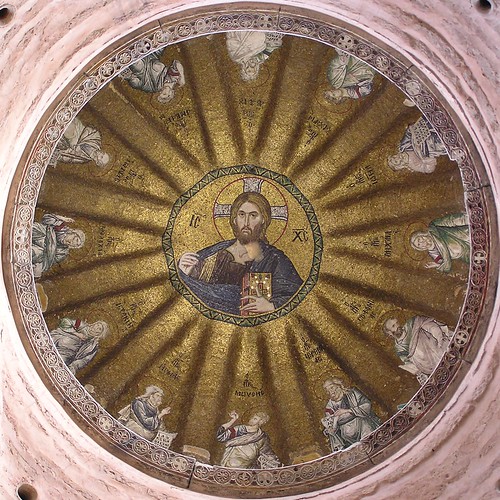
St. Chora Church dome: High Definition photo or mosaics of Highest quality? This mosaic, in the southern dome of the inner narthex, depicts the ancestry of Christ and his ancestors. In particular, Adam through Jacob are listed, along with the sons of Jacob. (Photo Mirari Erdoiza)
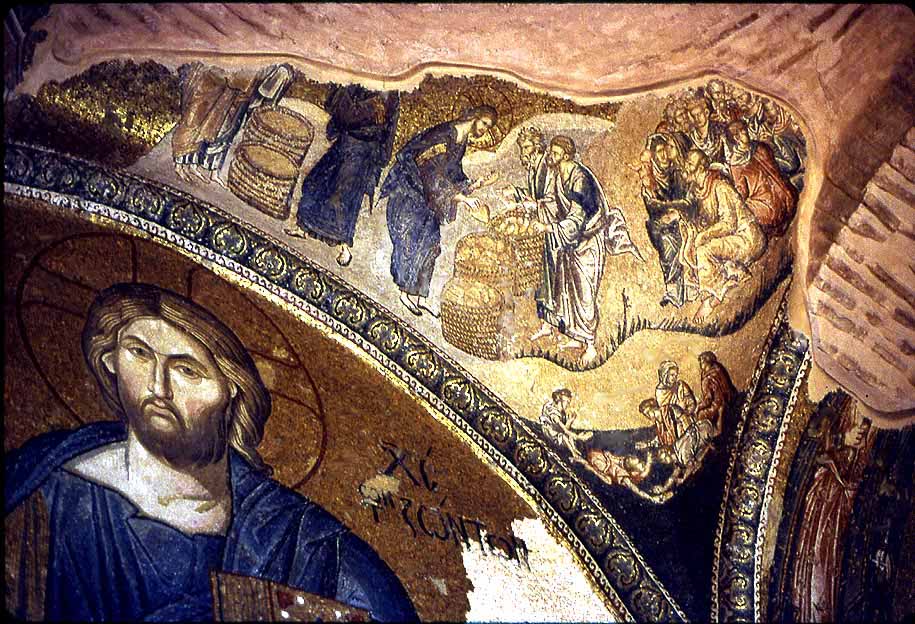
St. Chora: Christ the Savior (Left) and the miracle of Christ multiplying the bread to feed the 5000 followers. (Photo: Rolfgross)
HD screens are not needed here: You have to see to believe that this is not some modern poster, painting or a fresco. This is the mosaic just inside the main door. It depicts the famous image of Christ Pantocrator (Photo: pages.pomona.edu)

St. Chora: Byzantine mosaic depiction of Christ. When the church was built in the 5th Century, Istanbul was still known as Constantinople. The mosaic tiles were added to the interior walls in the 14th century and are considered to be amongst the finest examples of Byzantine art.
St. Chora: Mosaic of the journey to Bethlehem (photo: choramuseum.com).The walls are decorated with superb 14th century mosaics, illustrating scenes from the life of Christ and the Virgin Mary. These are the finest masterpieces of Christian religious art to be found anywhere in the world. Paintings, rocks and architectural designs seen in the background make the pictures three-dimensional. The scenes are made with special care for them to look daily, lively and ordinary. The scenes are enriched with explicating stories near them. 
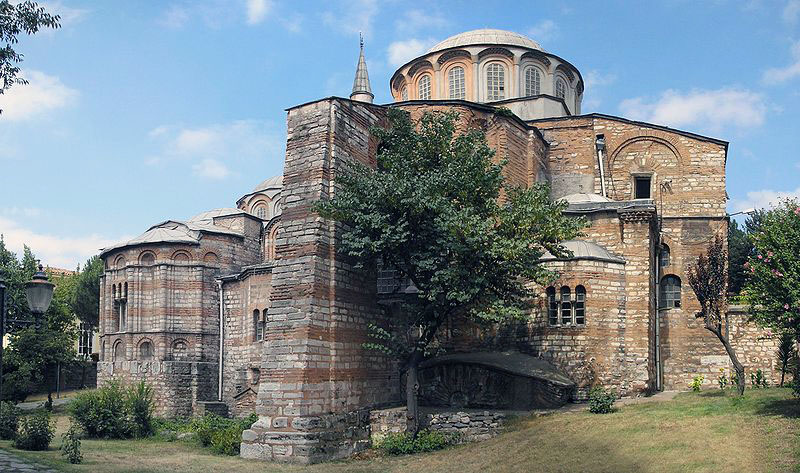
Like the mosaics and the frescoes inside, the architecture of the St. Chora is artfully distorted, chaotic, asymmetrical and decorative. (Choramuseum.com)


Mosaic closeup: small mosaic ceramic pieces at Chora in need of repair, showing the stunning range of colors used. It’s not easy to do but it is well worth the effort. The interior walls are covered with exquisite Byzantine religious art that has no equal anywhere in the world. (Choramuseum.com)
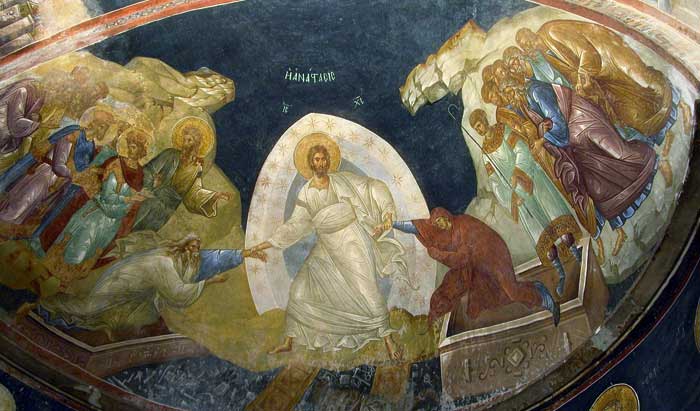

The Frescoes in St Chora are also in High Definition: This is the Anastasis (or Resurrection) scene. Christ, who had just broken down the gates of Hell, is standing in the middle and trying to pull Adam and Eve out of their tombs. Behind Adam stand John the Baptist, David and Solomon. Others are righteous kings;(Photo:Mlahannas.de)


Constantinople's defensive walls today, near the St Chora church: a stunning contrast of Old and New: These walls are named after Emperor Theodosius, and I took this picture at Edirnekapi very near the point the Ottoman army finally breached the Byzantine defenses and conquered the besieged city in 1453. The Chora church is only a few hundred feet away. The mobile fruit vendor, the black Audi and the car behind parked in an opposite direction make a stunning tableau of this historic place. Climbing these monstrous fortifications gave me my first ever vertigo and I really feared for my life unsure how to come down safely without losing my balance. (Photo: Krikor Tersakian)

The St. Chora when it was still used as a Mosque then still called Kariye Camii (circa 1904). The mosaics were under then hidden under a layer of white plaster hiding them from view and few knew about their existence.  Note the Golden Horn and Beyoglu Pera at the far left. This area now is totally surrounded by concrete working class dwellings and known to be  a conservative Muslim Fatih neighborhood.

The Pammakaristos church: Another forgotten Byzantine jewel


Only a few hundred meters from the St. Chora stands another masterpiece of Byzantine culture, namely the Pammakaristos (Greek: Θεοτόκος ἡ Παμμακάριστος, "All-Blessed Mother of God") church which is today known as the Fethiye Mosque or museum. It does have very valuable mosaics even though not as elaborate as those at the St. Chora. It is in the area called Çarsamba in Fatih neighborhood and was built on the fifth hill of Constantinople in the beginning of 12th century and then rebuilt in the 13th century by Michael Glabas Ducas Tarchaniotes, nephew of the emperor Michael VIII Palaeologos. After the fall of the City in 1453, Pammakaristos was used as a nunnery and then it became the see of the exiled Orthodox Patriarchate from 1455 until 1587.
In 1590, the church was inevitably converted into a mosque Fethiye (conquest or conqueror), in order to commemorate the conquest of Georgia and Azerbaijan by the Turks under the reign of Sultan Murad III during the Iranian war. A part of the apse was removed and a niche (Mihrab) was built showing the direction of Mecca for Muslim prayers along with a minaret and a religious teaching school or madrassah.
Pammakaristos church was then neglected for a long period until its restoration in 1949 by the Byzantine Institute of America (see details below). Just like the St. Chora, in the mid 20th century the frescoes and mosaics were cleaned and the famous church became a museum but it is far less visited than the St Chora and understandably so.
 At the entrance, there is a well preserved frescoes on the wall with "three wise men", and some fragments of other frescoes. Inside the dome and the interior walls of the parekkleison are covered with mosaics from the 14th century. The dome is decorated with Christ Pantokrator and the Twelve Prophets. In the apsis, there are figures of Christ with Virgin Mary and John the Baptist forming the Deesis, and archangels watching them. In the vaults and arches, there are scenes of the Baptism, and of several saints and monks of the church (www.greatistanbul.com)
 
 Pammakaristos Pantocrator church dome mosaics: (Photo: phool 4xc FlickR)


Pammakaristos: St. Gregory Illuminator (Սուրբ Գրիգոր Լուսաւորիչ) mosaic   14th century: St Gregory or Krikor was the driving force behind the conversion of Armenia from paganism to Christianity in 301 A.D. and hence the founder of the Armenian Apostolic church. He was initially imprisoned by the Armenian king Tirdad I (Տրդատ թագաւոր) but he managed to convert the King to Christianity along with the Nation (the first in the world to do so). His son Aristakes was his successor as head of the newly formed Church and took part to the famous First council of Nicaea in 325 A.D., the first ecumenical council of bishops of the Christian Church under Constantine. The above mosaic at the Pammakaristos church is very interesting but a bit odd given the conflict and competition opposing the Byzantines to the independent Armenian Apostolic church. 


This mosaic at Haghia Sofia may be the most famous of them all, but the overall quality of the surviving artwork (frescoes and mosaics) at St Chora is in a different league. (Photo: Krikor Tersakian)


Real life Indiana Jones: In 1948, Thomas Whittemore (1871 – 1950) and Paul A. Underwood, from the Byzantine Institute of America and the Dumbarton Oaks Center for Byzantine Studies, sponsored a program for restoration of the Chora in Istanbul. Thomas Whittemore was a scholar, archaeologist, born in Cambridge, Massachusetts in 1871. His good personal relationship with Ataturk enabled him to gain permission from the government to start the preservation and restoration of the Haghia Sophia mosaics in 1931. Under the plaster he discovered close to a thousand years of history—in silver, gold, marble, and sparkling glass cubes put together into a parade of saints and influential sinners which stretches from 537 to 1453 A.D., when the Turks came marching in, and then started work at the Chora restoring the place to its splendor (Choramuseum.com)


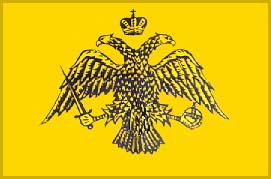
Bicephalous Eagle: The Byzantine Imperial flag: The double-headed eagle was the symbol of the Palaiologos, the last Greek-speaking "Roman" dynasty to rule from Constantinople. Emperor Michael VIII Palaiologos recaptured Constantinople from the catholic Crusaders in 1261, from a state based in Asia Minor; the double-headed eagle symbolized the dynasty and was kept despite the fact that virtually all of the Asian possessions were being gradually gobbled up by the Turks. This symbol was also adopted by the Greek Orthodox Ecumenical Patriarchate as well as the Russians.
The tragedy of open air mosaics and historical treasures in the Middle East 
Beit Meri, Lebanon: an example of open air Roman mosaic floor in total neglect


I grew up an Lebanon, a country considered to be an open air museum. The country is small in size, but few can claim to have seen all the historical sites the cradle of ancient Phoenicia has to offer. From the earliest human settlements all the way to Hellenistic, Roman, Byzantine, Arab, Crusader, Mameluke, Ottoman or French colonial rule, the country is a one stop shopper's paradise. However all is not so rosy. Some sites are unprotected and the concrete urban jungle threatens most. The Lebanese National Museum with all its unique Phoenician and other treasures was heavily damaged and sacked during the civil war.  But this is by no means a tragedy unique to Lebanon. Archaeological sites across the region are left unprotected and are crying for help.

Another tragedy happened in Baghdad upon the absurd Iraqi invasion by all time great American visionary leader and philosopher called George W. Bush. More than ten thousands antiquities of different sizes were looted in April 2003 from the National museum. These unique treasures were illegally sold all around the world, but fortunately most but not all were eventually recovered. In a typical answer as to why the US forces did not secure the museum from theft and looting, the official answer from the General Richard Myers was that while the looting was taking place at the museum, lots of people were dying because of the fighting. Therefore the museum with the unique Mesopotamian artifacts was not a priority for the attacking troops...

As for mosaics, the picture is even bleaker in the region because of the very fragile nature of these assemblages. For example when I was a kid, we used to sometimes visit the Roman site in the Village of Beit Meri near Beirut where there are open air mosaics  and we used to actually walk on them just for fun! Yes, we were pretty ignorant, innocent and supervision free to walk on these thousand years mosaics. I still deeply regret doing so.
The sorry state of some archaeological sites in the Near East and elsewhere is beyond belief even though deliberate acts of vandalism seem to be rare. But is this acceptable ?
There are not many options available other than the complete protection of all historical sites with the help (both financial and technical) of the International community, agencies, universities and even philanthropists who understand a basic fact: what is lost today is never recovered.

The great 19th century Armenian Humorist / Satirist Hagop Baronian (1843 Edirne-1891 Constantinople) summed it best: ''Look to your rear side to see in front of you'' (Ետեւդ նայիր որ առջեւդ տեսնես). That is, History is not just the past, it is also the best interpretation and the road map to understand and somehow predict the future.
 
Tyre, Lebanon: Neglected open air mosaics. It is in the Roman period that mosaics in Lebanon started to appear.The Hellenistic period from 400 B.C until the Roman period have not yielded any mosaic pavement in Lebanon particular during its prosperous period of the 2nd century A.C-Mosaics continue to flourish during the Byzantine period until the Arab conquest. Important finds of mosaic pavements have been made in many archaeological sites, in churches and in ancient houses.  Lebanon has become thus one of the most important centers for the study of mosaics. (Photos: Cedarrick)
Lebanon mosaics in total neglect: Please, please, please: Can anyone be caring and smart enough to put these broken mosaic pieces together and lift them a few centimeters off the ground for protection?  Or maybe not. After all, not many care...

Krikor Tersakian  June 2010, Canada

Sunday, November 15, 2009

The Istanbul Pogroms of 1955: The tragic expulsion of the Greeks


The 1955 Istanbul Pogroms by Turkish mobs: They attacked mostly Greeks, but also the Armenians, and Jews. An estimated 15 were killed. More than 3500 homes and 5000 shops were destroyed . It was the end of the Greek community's significant presence since the ancient times.


The 6 September 1955 was a very black day indeed. A day when thousands of organized Turkish mobs targeted mainly the Greek community but also other minorities in Istanbul with the clear intent to do as much harm as possible. They burned, looted and destroyed thousands of previously marked and identified businesses belonging to Greeks and also to Armenians. They desecrated cemeteries, attacked 72 churches, hundreds of homes, killing at least 15 innocent people. Even more tragically, these pogroms put an end to any significant Greek presence in the city since thousands of years. The numbers of Greeks dropped rapidly after these attacks and today there are fewer than 1500 mostly elderly Greeks left. 

It was the end of what was left of an all encompassing and historical Constantinople-IstanbulThese 1955 attacks were dubbed the "Greek Kristallnacht", echoing the tragic night the Jews and their businesses were attacked by Nazi thugs in 1938 in a prelude of much more serious assault hat followed.(Kristallnacht or Crystal Night refers to the piles of broken glass strewn on the sidewalks and streets after the Nazi attacks on November 9, 1938).

Who could have designed such an outrageous attack on unarmed and unprotected minorities in the metropolis and how come the authorities did not intervene and let the rioters execute their plans with such vast magnitude and total impunity? 


September 1955: The rioters did everything to destroy the maximum possible within the shortest period of time. They knew that the police were not about to intervene, but had to act fast nonetheless. Their message to the Greek community was "We are throwing you out Now". These savage perpetrators were the most "active" in the Beyoglu/ Pera area. They damaged much more than just property: They killed what was left of Istanbul's cosmopolitan spirit and history.

The Istanbul Pogrom are also known as the Istanbul Riots, or the Σεπτεμβριανά in Greek and the 6-7 Eylul Olayları in Turkish (both literally Events of September). It was a pogrom directed primarily at Istanbul’s 100,000-strong Greek minority. Jews and Armenians living in the city and their businesses were also targeted in the pogrom, which was orchestrated by the Demokrat Parti-government of Turkish Prime Minister Adnan Menderes along with the political, bureaucratic and military establishment, that is mysteriously called Dervin Devlet or the Deep State. But how did it all start and why?

Prior to the actual pogroms, the tensions between Greece and Turkey had risen to new heights over the Cyprus impasse. Tensions were boiling over on both sides as the Greek Cypriots National Organization of Cypriot Fighters (known as EOKA) were engaging in an open armed struggle against the British colonial powers in order to achieve the unification of their Island with Greece. Cyprus was the issue but the relations between Turks and Greeks needs no introduction. These Greece-Cyprus unification campaigns were of course totally unacceptable to Ankara. Turkish anti Greek nationalist sentiments were rising as high as the economic inflation in Turkey... The Turks were furious and various groups were staging all kinds of protests against the Greeks and their apparent support of the Cyprus unification plans and actions. The tensions were very high indeed, but the actual pogroms needed a sparking plug to light the fire fueled by this explosive mixture of misinformation, cheap propaganda, political manipulation, religious intolerance and plain ignorance.

The needed spark plug was indeed missing, but the Turkish authorities or Services did their job and devised a workable plot: A bomb was sent secretly from Turkey to the Greek city of Salonika and set to target Turkish leader Mustafa Kemal Ataturk's birthplace in that city. That building was serving as the Turkish Consulate at that time. The news of such an intended "Greek" or "Rumeli" attack on Ataturk's sacrosanct birthplace (and Turkish consulate) was surely a very convenient way for the authorities to start the planned pogrom in Istanbul against the local Greek population. The "Greeks are attacking Ataturk and Turkey" was a pretty good slogan or rallying cry to start the attacks in Istanbul.


The actual riots started at 5.50pm on Sept. 6 1955, when thousands of these rioters arrived mainly to the Beyoglu district. They were mostly bused or taxied from the western Anatolia. There are reports that at least 500 of them were from the Eksisehir area, along with their party officials and "technical support" and "supervision" staff. They were all promised money for their efforts as well as booty and the satisfaction of "teaching the enemy a historical lesson".

The mobs were also well equipped and informed with specific lists of addresses to attack. Some businesses or homes were even pre-marked to facilitate the targeted attacks. The hundreds of rioters were divided into 40-50 men contingents and dispatched to various areas along with their band leaders. On the ''logistics'' front, buses belonging to municipalities were parked in strategic locations in order to hand out hammers, crowbars, gasoline and others tools of destruction to these rioters.


1955 pogroms: A destroyed and desecrated Greek cemetery after some friendly visit from the mob acting to inflict the most damage to the community in the shortest possible time...


The rioters soon started to smash everything they could. They destroyed the metal doors, ransacked, pillaged and set on fire everything on their lists. The looting was incredible: businesses were totally emptied of their merchandise, stolen goods taken away in trucks and the locations destroyed. Churches, stores, apartments, cemeteries: nothing was spared. The attackers came wave after wave, did their damage, and left. The second wave, the third wave, while the police or the army were nowhere to be seen. After all, this was a governmental plan, even though executed by "civilians" as a popular outburst against the Rumeli (Greek orthodox) "enemy" within the Turkish Republic. "Death to Gyavurs" and "Kill the Greeks" were the most common slogans chanted by these provincial henchmen.

The pogromist were not instructed to kill, but they still managed to kill more than 15 through beatings and arson. In total 73 churches, 20 factories. 1000 homes and more than 20 schools were attacked over and above 5000 properties looted, burned or destroyed. The majority of attacks were in Istanbul but there were also attacks elsewhere, like Izmir. Exact statistics are impossible, because statistics need data collection and no data was collected of course...The riots officially ceased after midnight, or more precisely at 2.00 am. of September 7, 1955 when the Turkish Army finally moved in and kindly urged the rioters to leave. Martial law was also declared, but all this was already too little to late. That military intervention was like the final act of the burlesque tragedy-comedy. The curtain came down, and another very clack chapter was written in the history books. 

Five years later, the Prime Minister of the day Adnan Menderes and his hard-line Foreign Affairs minister Fatin Zorlu were arrested along with other Demokrat Parti. They were arrested and put collectively to trial after the Army took powers and deposed the Government on 27 May 1960. Menderes was jailed in the island of Yessiada near Istanbul where he faced various charges and a trial, including accusations about the organization and execution of the Istanbul pogroms. The military trials were not "open", but it is reported that Minister Zorlu's lawyer claimed or admitted that the pogroms were all orchestrated and that effectively countless thousands were brought to Istanbul from areas in a radius of 60 km around the city.


Menderes was found guilty and executed at the gallows on 17 September 1961 on the island of Imrali. He was pardoned posthumously in 1990, his remains moved to a private mausoleum and even had an International Airport (Izmir) renamed after him! (Note: it is interesting that presently P.K.K. leader Abdullah Ocalan is the lone prisoner on this infamous island of Imrali, in the sea of Marmara where Menderes was executed).


The 1955 rioters in very celebratory mood during their rampage while, below...


...The Greek Patriarch Athenagoras is inspecting and lamenting in a desecrated Orthodox church in Istanbul. He was a lonely figure indeed and did not get much help or protection. The condemnations were not enough to rebuild all the destruction and halt the forced exodus of his flock.


Being married to a woman from Istanbul, I have heard and seen enough to fully grasp the very deep shock that the 1955 riots caused and still do. My late father- in- law Vahan used to say that the 1955 pogroms were as devastating as any other event, shaking not only the Greeks, but also the collective psyche and insecurity feeling of Jews and Armenians, prompting massive immigration in the months and years that followed these pogroms.

Although the Greeks had lost Constantinople in 1453, the conquering Ottomans  had not expelled the Greek community. Various restrictions were put in place but life went on for a considerable community that prospered throughout the centuries and greatly helped the development of the City. The establishment of the Greek state in 1829, the Greek-Turkish war of 1919-1922 were low points of course in Greek-Turkish relationships. In the 1930's the situation got even worse as very restrictive and racist laws were passed against the minorities, such as trade restriction, church and school jurisdiction limitations etc. The straw that broke the camel's back, however, was the Cyprus problem and the Istanbul riots that followed.


The Greek community fell from  more than 100,000 to under 1500 within a few years. When I dared to enter the Ortakoy Greek Orthodox church on a Sunday morning church "rush hour", this important church was completely empty. Not a soul except a young apprentice deacon saying prayers in Greek. Upon noticing me, he was so surprised that he slowly walked behind the altar to notify his senior that someone had in fact entered their church and was attending the mess. Subsequently they were both staring at me with suspicion while performing their duties, until I did the sign of cross and obviously appeased their worst fears.

My father in law Vahan who left Istanbul as a direct result of the Pogroms used to joke: "Today, it is much easier to find a Giraffe in Paris than a Greek in Istanbul". A sad fact that Istanbul owes to the orchestrated pogroms of 1955.


The Greek Consulate in Istanbul attacked in 2008 during protests against some Greek Government's internal policy. Workers clean red paint sprayed on the Consulate, which is located on Istiklal Caddesi the exact scene of the 1955 riots. 


The Armenian Patriarchate in Istanbul (Kum Kapi) is now under 24/7 police protection. The Patriarchate and the Istanbul Patriarch Moutafian himself were lately said to be on an underground group hit list. After conquering Constantinople in 1453, the Ottomans allowed the Greek Orthodox Patriarchate to remain in the city. In 1461 Sultan Mehmed II also invited the Armenians to establish their own Patriarchate as part of the Millet system. The Byzantines and Armenians always considered each other as heretical (since the split that occured at the council of Chalcedon in 451 a.d.) (photo: Krikor Tersakian)


The Istiklal Pera pedestrian street today, the neighborhood where most of the 1955 riots occurred: How many of these vibrant and happy looking youth actually know much about the tragic events that happened right there? Most of the younger generation did not know much about these tragic attacks until a movie called "Guz Sancisi" (by young Turkish woman director Tomris Giritlioglu) was screened in local theaters to great public surprise and success.(Photo: Krikor Tersakian, 2009)


Déjà-Vu in 2009: Istanbul’s Christian cemeteries are still being desecrated, despite the ugly 1955 legacy. This particular one is in historic cemetery near the ancient Valukli Monastery located outside the ancient walls of Theodosius. Ecumenical Patriarch Bartholomew (pictured) visiting the desecrated cemetery, surely wondering what more can still go wrong. 90 tombstones bearing a cross were destroyed. Some attacks may be driven by hatred while others have economic reasons, instigated by real state developers who badly want the cemeteries or church properties for their projects (Photo: Nikos Manginas)


© Krikor Tersakian, 2009

The Istanbul Pogroms of 1955: The tragic expulsion of the Greeks


The 1955 Istanbul Pogroms by Turkish mobs: They attacked mostly Greeks, but also the Armenians, and Jews. An estimated 15 were killed. More than 3500 homes and 5000 shops were destroyed . It was the end of the Greek community's significant presence since the ancient times.


The 6 September 1955 was a very black day indeed. A day when thousands of organized Turkish mobs targeted mainly the Greek community but also other minorities in Istanbul with the clear intent to do as much harm as possible. They burned, looted and destroyed thousands of previously marked and identified businesses belonging to Greeks and also to Armenians. They desecrated cemeteries, attacked 72 churches, hundreds of homes, killing at least 15 innocent people. Even more tragically, these pogroms put an end to any significant Greek presence in the city since thousands of years. The numbers of Greeks dropped rapidly after these attacks and today there are fewer than 1500 mostly elderly Greeks left. 

It was the end of what was left of an all encompassing and historical Constantinople-IstanbulThese 1955 attacks were dubbed the "Greek Kristallnacht", echoing the tragic night the Jews and their businesses were attacked by Nazi thugs in 1938 in a prelude of much more serious assault hat followed.(Kristallnacht or Crystal Night refers to the piles of broken glass strewn on the sidewalks and streets after the Nazi attacks on November 9, 1938).

Who could have designed such an outrageous attack on unarmed and unprotected minorities in the metropolis and how come the authorities did not intervene and let the rioters execute their plans with such vast magnitude and total impunity? 


September 1955: The rioters did everything to destroy the maximum possible within the shortest period of time. They knew that the police were not about to intervene, but had to act fast nonetheless. Their message to the Greek community was "We are throwing you out Now". These savage perpetrators were the most "active" in the Beyoglu/ Pera area. They damaged much more than just property: They killed what was left of Istanbul's cosmopolitan spirit and history.

The Istanbul Pogrom are also known as the Istanbul Riots, or the Σεπτεμβριανά in Greek and the 6-7 Eylul Olayları in Turkish (both literally Events of September). It was a pogrom directed primarily at Istanbul’s 100,000-strong Greek minority. Jews and Armenians living in the city and their businesses were also targeted in the pogrom, which was orchestrated by the Demokrat Parti-government of Turkish Prime Minister Adnan Menderes along with the political, bureaucratic and military establishment, that is mysteriously called Dervin Devlet or the Deep State. But how did it all start and why?

Prior to the actual pogroms, the tensions between Greece and Turkey had risen to new heights over the Cyprus impasse. Tensions were boiling over on both sides as the Greek Cypriots National Organization of Cypriot Fighters (known as EOKA) were engaging in an open armed struggle against the British colonial powers in order to achieve the unification of their Island with Greece. Cyprus was the issue but the relations between Turks and Greeks needs no introduction. These Greece-Cyprus unification campaigns were of course totally unacceptable to Ankara. Turkish anti Greek nationalist sentiments were rising as high as the economic inflation in Turkey... The Turks were furious and various groups were staging all kinds of protests against the Greeks and their apparent support of the Cyprus unification plans and actions. The tensions were very high indeed, but the actual pogroms needed a sparking plug to light the fire fueled by this explosive mixture of misinformation, cheap propaganda, political manipulation, religious intolerance and plain ignorance.

The needed spark plug was indeed missing, but the Turkish authorities or Services did their job and devised a workable plot: A bomb was sent secretly from Turkey to the Greek city of Salonika and set to target Turkish leader Mustafa Kemal Ataturk's birthplace in that city. That building was serving as the Turkish Consulate at that time. The news of such an intended "Greek" or "Rumeli" attack on Ataturk's sacrosanct birthplace (and Turkish consulate) was surely a very convenient way for the authorities to start the planned pogrom in Istanbul against the local Greek population. The "Greeks are attacking Ataturk and Turkey" was a pretty good slogan or rallying cry to start the attacks in Istanbul.


The actual riots started at 5.50pm on Sept. 6 1955, when thousands of these rioters arrived mainly to the Beyoglu district. They were mostly bused or taxied from the western Anatolia. There are reports that at least 500 of them were from the Eksisehir area, along with their party officials and "technical support" and "supervision" staff. They were all promised money for their efforts as well as booty and the satisfaction of "teaching the enemy a historical lesson".

The mobs were also well equipped and informed with specific lists of addresses to attack. Some businesses or homes were even pre-marked to facilitate the targeted attacks. The hundreds of rioters were divided into 40-50 men contingents and dispatched to various areas along with their band leaders. On the ''logistics'' front, buses belonging to municipalities were parked in strategic locations in order to hand out hammers, crowbars, gasoline and others tools of destruction to these rioters.


1955 pogroms: A destroyed and desecrated Greek cemetery after some friendly visit from the mob acting to inflict the most damage to the community in the shortest possible time...


The rioters soon started to smash everything they could. They destroyed the metal doors, ransacked, pillaged and set on fire everything on their lists. The looting was incredible: businesses were totally emptied of their merchandise, stolen goods taken away in trucks and the locations destroyed. Churches, stores, apartments, cemeteries: nothing was spared. The attackers came wave after wave, did their damage, and left. The second wave, the third wave, while the police or the army were nowhere to be seen. After all, this was a governmental plan, even though executed by "civilians" as a popular outburst against the Rumeli (Greek orthodox) "enemy" within the Turkish Republic. "Death to Gyavurs" and "Kill the Greeks" were the most common slogans chanted by these provincial henchmen.

The pogromist were not instructed to kill, but they still managed to kill more than 15 through beatings and arson. In total 73 churches, 20 factories. 1000 homes and more than 20 schools were attacked over and above 5000 properties looted, burned or destroyed. The majority of attacks were in Istanbul but there were also attacks elsewhere, like Izmir. Exact statistics are impossible, because statistics need data collection and no data was collected of course...The riots officially ceased after midnight, or more precisely at 2.00 am. of September 7, 1955 when the Turkish Army finally moved in and kindly urged the rioters to leave. Martial law was also declared, but all this was already too little to late. That military intervention was like the final act of the burlesque tragedy-comedy. The curtain came down, and another very clack chapter was written in the history books. 

Five years later, the Prime Minister of the day Adnan Menderes and his hard-line Foreign Affairs minister Fatin Zorlu were arrested along with other Demokrat Parti. They were arrested and put collectively to trial after the Army took powers and deposed the Government on 27 May 1960. Menderes was jailed in the island of Yessiada near Istanbul where he faced various charges and a trial, including accusations about the organization and execution of the Istanbul pogroms. The military trials were not "open", but it is reported that Minister Zorlu's lawyer claimed or admitted that the pogroms were all orchestrated and that effectively countless thousands were brought to Istanbul from areas in a radius of 60 km around the city.


Menderes was found guilty and executed at the gallows on 17 September 1961 on the island of Imrali. He was pardoned posthumously in 1990, his remains moved to a private mausoleum and even had an International Airport (Izmir) renamed after him! (Note: it is interesting that presently P.K.K. leader Abdullah Ocalan is the lone prisoner on this infamous island of Imrali, in the sea of Marmara where Menderes was executed).


The 1955 rioters in very celebratory mood during their rampage while, below...


...The Greek Patriarch Athenagoras is inspecting and lamenting in a desecrated Orthodox church in Istanbul. He was a lonely figure indeed and did not get much help or protection. The condemnations were not enough to rebuild all the destruction and halt the forced exodus of his flock.


Being married to a woman from Istanbul, I have heard and seen enough to fully grasp the very deep shock that the 1955 riots caused and still do. My late father- in- law Vahan used to say that the 1955 pogroms were as devastating as any other event, shaking not only the Greeks, but also the collective psyche and insecurity feeling of Jews and Armenians, prompting massive immigration in the months and years that followed these pogroms.

Although the Greeks had lost Constantinople in 1453, the conquering Ottomans  had not expelled the Greek community. Various restrictions were put in place but life went on for a considerable community that prospered throughout the centuries and greatly helped the development of the City. The establishment of the Greek state in 1829, the Greek-Turkish war of 1919-1922 were low points of course in Greek-Turkish relationships. In the 1930's the situation got even worse as very restrictive and racist laws were passed against the minorities, such as trade restriction, church and school jurisdiction limitations etc. The straw that broke the camel's back, however, was the Cyprus problem and the Istanbul riots that followed.


The Greek community fell from  more than 100,000 to under 1500 within a few years. When I dared to enter the Ortakoy Greek Orthodox church on a Sunday morning church "rush hour", this important church was completely empty. Not a soul except a young apprentice deacon saying prayers in Greek. Upon noticing me, he was so surprised that he slowly walked behind the altar to notify his senior that someone had in fact entered their church and was attending the mess. Subsequently they were both staring at me with suspicion while performing their duties, until I did the sign of cross and obviously appeased their worst fears.

My father in law Vahan who left Istanbul as a direct result of the Pogroms used to joke: "Today, it is much easier to find a Giraffe in Paris than a Greek in Istanbul". A sad fact that Istanbul owes to the orchestrated pogroms of 1955.


The Greek Consulate in Istanbul attacked in 2008 during protests against some Greek Government's internal policy. Workers clean red paint sprayed on the Consulate, which is located on Istiklal Caddesi the exact scene of the 1955 riots. 


The Armenian Patriarchate in Istanbul (Kum Kapi) is now under 24/7 police protection. The Patriarchate and the Istanbul Patriarch Moutafian himself were lately said to be on an underground group hit list. After conquering Constantinople in 1453, the Ottomans allowed the Greek Orthodox Patriarchate to remain in the city. In 1461 Sultan Mehmed II also invited the Armenians to establish their own Patriarchate as part of the Millet system. The Byzantines and Armenians always considered each other as heretical (since the split that occured at the council of Chalcedon in 451 a.d.) (photo: Krikor Tersakian)


The Istiklal Pera pedestrian street today, the neighborhood where most of the 1955 riots occurred: How many of these vibrant and happy looking youth actually know much about the tragic events that happened right there? Most of the younger generation did not know much about these tragic attacks until a movie called "Guz Sancisi" (by young Turkish woman director Tomris Giritlioglu) was screened in local theaters to great public surprise and success.(Photo: Krikor Tersakian, 2009)


Déjà-Vu in 2009: Istanbul’s Christian cemeteries are still being desecrated, despite the ugly 1955 legacy. This particular one is in historic cemetery near the ancient Valukli Monastery located outside the ancient walls of Theodosius. Ecumenical Patriarch Bartholomew (pictured) visiting the desecrated cemetery, surely wondering what more can still go wrong. 90 tombstones bearing a cross were destroyed. Some attacks may be driven by hatred while others have economic reasons, instigated by real state developers who badly want the cemeteries or church properties for their projects (Photo: Nikos Manginas)


© Krikor Tersakian Montreal Canada 2009