Showing posts with label Chalcedon. Show all posts

Sunday, November 15, 2009

The Istanbul Pogroms of 1955: The tragic expulsion of the Greeks


The 1955 Istanbul Pogroms by Turkish mobs: They attacked mostly Greeks, but also the Armenians, and Jews. An estimated 15 were killed. More than 3500 homes and 5000 shops were destroyed . It was the end of the Greek community's significant presence since the ancient times.


The 6 September 1955 was a very black day indeed. A day when thousands of organized Turkish mobs targeted mainly the Greek community but also other minorities in Istanbul with the clear intent to do as much harm as possible. They burned, looted and destroyed thousands of previously marked and identified businesses belonging to Greeks and also to Armenians. They desecrated cemeteries, attacked 72 churches, hundreds of homes, killing at least 15 innocent people. Even more tragically, these pogroms put an end to any significant Greek presence in the city since thousands of years. The numbers of Greeks dropped rapidly after these attacks and today there are fewer than 1500 mostly elderly Greeks left. 

It was the end of what was left of an all encompassing and historical Constantinople-IstanbulThese 1955 attacks were dubbed the "Greek Kristallnacht", echoing the tragic night the Jews and their businesses were attacked by Nazi thugs in 1938 in a prelude of much more serious assault hat followed.(Kristallnacht or Crystal Night refers to the piles of broken glass strewn on the sidewalks and streets after the Nazi attacks on November 9, 1938).

Who could have designed such an outrageous attack on unarmed and unprotected minorities in the metropolis and how come the authorities did not intervene and let the rioters execute their plans with such vast magnitude and total impunity? 


September 1955: The rioters did everything to destroy the maximum possible within the shortest period of time. They knew that the police were not about to intervene, but had to act fast nonetheless. Their message to the Greek community was "We are throwing you out Now". These savage perpetrators were the most "active" in the Beyoglu/ Pera area. They damaged much more than just property: They killed what was left of Istanbul's cosmopolitan spirit and history.

The Istanbul Pogrom are also known as the Istanbul Riots, or the Σεπτεμβριανά in Greek and the 6-7 Eylul Olayları in Turkish (both literally Events of September). It was a pogrom directed primarily at Istanbul’s 100,000-strong Greek minority. Jews and Armenians living in the city and their businesses were also targeted in the pogrom, which was orchestrated by the Demokrat Parti-government of Turkish Prime Minister Adnan Menderes along with the political, bureaucratic and military establishment, that is mysteriously called Dervin Devlet or the Deep State. But how did it all start and why?

Prior to the actual pogroms, the tensions between Greece and Turkey had risen to new heights over the Cyprus impasse. Tensions were boiling over on both sides as the Greek Cypriots National Organization of Cypriot Fighters (known as EOKA) were engaging in an open armed struggle against the British colonial powers in order to achieve the unification of their Island with Greece. Cyprus was the issue but the relations between Turks and Greeks needs no introduction. These Greece-Cyprus unification campaigns were of course totally unacceptable to Ankara. Turkish anti Greek nationalist sentiments were rising as high as the economic inflation in Turkey... The Turks were furious and various groups were staging all kinds of protests against the Greeks and their apparent support of the Cyprus unification plans and actions. The tensions were very high indeed, but the actual pogroms needed a sparking plug to light the fire fueled by this explosive mixture of misinformation, cheap propaganda, political manipulation, religious intolerance and plain ignorance.

The needed spark plug was indeed missing, but the Turkish authorities or Services did their job and devised a workable plot: A bomb was sent secretly from Turkey to the Greek city of Salonika and set to target Turkish leader Mustafa Kemal Ataturk's birthplace in that city. That building was serving as the Turkish Consulate at that time. The news of such an intended "Greek" or "Rumeli" attack on Ataturk's sacrosanct birthplace (and Turkish consulate) was surely a very convenient way for the authorities to start the planned pogrom in Istanbul against the local Greek population. The "Greeks are attacking Ataturk and Turkey" was a pretty good slogan or rallying cry to start the attacks in Istanbul.


The actual riots started at 5.50pm on Sept. 6 1955, when thousands of these rioters arrived mainly to the Beyoglu district. They were mostly bused or taxied from the western Anatolia. There are reports that at least 500 of them were from the Eksisehir area, along with their party officials and "technical support" and "supervision" staff. They were all promised money for their efforts as well as booty and the satisfaction of "teaching the enemy a historical lesson".

The mobs were also well equipped and informed with specific lists of addresses to attack. Some businesses or homes were even pre-marked to facilitate the targeted attacks. The hundreds of rioters were divided into 40-50 men contingents and dispatched to various areas along with their band leaders. On the ''logistics'' front, buses belonging to municipalities were parked in strategic locations in order to hand out hammers, crowbars, gasoline and others tools of destruction to these rioters.


1955 pogroms: A destroyed and desecrated Greek cemetery after some friendly visit from the mob acting to inflict the most damage to the community in the shortest possible time...


The rioters soon started to smash everything they could. They destroyed the metal doors, ransacked, pillaged and set on fire everything on their lists. The looting was incredible: businesses were totally emptied of their merchandise, stolen goods taken away in trucks and the locations destroyed. Churches, stores, apartments, cemeteries: nothing was spared. The attackers came wave after wave, did their damage, and left. The second wave, the third wave, while the police or the army were nowhere to be seen. After all, this was a governmental plan, even though executed by "civilians" as a popular outburst against the Rumeli (Greek orthodox) "enemy" within the Turkish Republic. "Death to Gyavurs" and "Kill the Greeks" were the most common slogans chanted by these provincial henchmen.

The pogromist were not instructed to kill, but they still managed to kill more than 15 through beatings and arson. In total 73 churches, 20 factories. 1000 homes and more than 20 schools were attacked over and above 5000 properties looted, burned or destroyed. The majority of attacks were in Istanbul but there were also attacks elsewhere, like Izmir. Exact statistics are impossible, because statistics need data collection and no data was collected of course...The riots officially ceased after midnight, or more precisely at 2.00 am. of September 7, 1955 when the Turkish Army finally moved in and kindly urged the rioters to leave. Martial law was also declared, but all this was already too little to late. That military intervention was like the final act of the burlesque tragedy-comedy. The curtain came down, and another very clack chapter was written in the history books. 

Five years later, the Prime Minister of the day Adnan Menderes and his hard-line Foreign Affairs minister Fatin Zorlu were arrested along with other Demokrat Parti. They were arrested and put collectively to trial after the Army took powers and deposed the Government on 27 May 1960. Menderes was jailed in the island of Yessiada near Istanbul where he faced various charges and a trial, including accusations about the organization and execution of the Istanbul pogroms. The military trials were not "open", but it is reported that Minister Zorlu's lawyer claimed or admitted that the pogroms were all orchestrated and that effectively countless thousands were brought to Istanbul from areas in a radius of 60 km around the city.


Menderes was found guilty and executed at the gallows on 17 September 1961 on the island of Imrali. He was pardoned posthumously in 1990, his remains moved to a private mausoleum and even had an International Airport (Izmir) renamed after him! (Note: it is interesting that presently P.K.K. leader Abdullah Ocalan is the lone prisoner on this infamous island of Imrali, in the sea of Marmara where Menderes was executed).


The 1955 rioters in very celebratory mood during their rampage while, below...


...The Greek Patriarch Athenagoras is inspecting and lamenting in a desecrated Orthodox church in Istanbul. He was a lonely figure indeed and did not get much help or protection. The condemnations were not enough to rebuild all the destruction and halt the forced exodus of his flock.


Being married to a woman from Istanbul, I have heard and seen enough to fully grasp the very deep shock that the 1955 riots caused and still do. My late father- in- law Vahan used to say that the 1955 pogroms were as devastating as any other event, shaking not only the Greeks, but also the collective psyche and insecurity feeling of Jews and Armenians, prompting massive immigration in the months and years that followed these pogroms.

Although the Greeks had lost Constantinople in 1453, the conquering Ottomans  had not expelled the Greek community. Various restrictions were put in place but life went on for a considerable community that prospered throughout the centuries and greatly helped the development of the City. The establishment of the Greek state in 1829, the Greek-Turkish war of 1919-1922 were low points of course in Greek-Turkish relationships. In the 1930's the situation got even worse as very restrictive and racist laws were passed against the minorities, such as trade restriction, church and school jurisdiction limitations etc. The straw that broke the camel's back, however, was the Cyprus problem and the Istanbul riots that followed.


The Greek community fell from  more than 100,000 to under 1500 within a few years. When I dared to enter the Ortakoy Greek Orthodox church on a Sunday morning church "rush hour", this important church was completely empty. Not a soul except a young apprentice deacon saying prayers in Greek. Upon noticing me, he was so surprised that he slowly walked behind the altar to notify his senior that someone had in fact entered their church and was attending the mess. Subsequently they were both staring at me with suspicion while performing their duties, until I did the sign of cross and obviously appeased their worst fears.

My father in law Vahan who left Istanbul as a direct result of the Pogroms used to joke: "Today, it is much easier to find a Giraffe in Paris than a Greek in Istanbul". A sad fact that Istanbul owes to the orchestrated pogroms of 1955.


The Greek Consulate in Istanbul attacked in 2008 during protests against some Greek Government's internal policy. Workers clean red paint sprayed on the Consulate, which is located on Istiklal Caddesi the exact scene of the 1955 riots. 


The Armenian Patriarchate in Istanbul (Kum Kapi) is now under 24/7 police protection. The Patriarchate and the Istanbul Patriarch Moutafian himself were lately said to be on an underground group hit list. After conquering Constantinople in 1453, the Ottomans allowed the Greek Orthodox Patriarchate to remain in the city. In 1461 Sultan Mehmed II also invited the Armenians to establish their own Patriarchate as part of the Millet system. The Byzantines and Armenians always considered each other as heretical (since the split that occured at the council of Chalcedon in 451 a.d.) (photo: Krikor Tersakian)


The Istiklal Pera pedestrian street today, the neighborhood where most of the 1955 riots occurred: How many of these vibrant and happy looking youth actually know much about the tragic events that happened right there? Most of the younger generation did not know much about these tragic attacks until a movie called "Guz Sancisi" (by young Turkish woman director Tomris Giritlioglu) was screened in local theaters to great public surprise and success.(Photo: Krikor Tersakian, 2009)


Déjà-Vu in 2009: Istanbul’s Christian cemeteries are still being desecrated, despite the ugly 1955 legacy. This particular one is in historic cemetery near the ancient Valukli Monastery located outside the ancient walls of Theodosius. Ecumenical Patriarch Bartholomew (pictured) visiting the desecrated cemetery, surely wondering what more can still go wrong. 90 tombstones bearing a cross were destroyed. Some attacks may be driven by hatred while others have economic reasons, instigated by real state developers who badly want the cemeteries or church properties for their projects (Photo: Nikos Manginas)


© Krikor Tersakian, 2009

The Istanbul Pogroms of 1955: The tragic expulsion of the Greeks


The 1955 Istanbul Pogroms by Turkish mobs: They attacked mostly Greeks, but also the Armenians, and Jews. An estimated 15 were killed. More than 3500 homes and 5000 shops were destroyed . It was the end of the Greek community's significant presence since the ancient times.


The 6 September 1955 was a very black day indeed. A day when thousands of organized Turkish mobs targeted mainly the Greek community but also other minorities in Istanbul with the clear intent to do as much harm as possible. They burned, looted and destroyed thousands of previously marked and identified businesses belonging to Greeks and also to Armenians. They desecrated cemeteries, attacked 72 churches, hundreds of homes, killing at least 15 innocent people. Even more tragically, these pogroms put an end to any significant Greek presence in the city since thousands of years. The numbers of Greeks dropped rapidly after these attacks and today there are fewer than 1500 mostly elderly Greeks left. 

It was the end of what was left of an all encompassing and historical Constantinople-IstanbulThese 1955 attacks were dubbed the "Greek Kristallnacht", echoing the tragic night the Jews and their businesses were attacked by Nazi thugs in 1938 in a prelude of much more serious assault hat followed.(Kristallnacht or Crystal Night refers to the piles of broken glass strewn on the sidewalks and streets after the Nazi attacks on November 9, 1938).

Who could have designed such an outrageous attack on unarmed and unprotected minorities in the metropolis and how come the authorities did not intervene and let the rioters execute their plans with such vast magnitude and total impunity? 


September 1955: The rioters did everything to destroy the maximum possible within the shortest period of time. They knew that the police were not about to intervene, but had to act fast nonetheless. Their message to the Greek community was "We are throwing you out Now". These savage perpetrators were the most "active" in the Beyoglu/ Pera area. They damaged much more than just property: They killed what was left of Istanbul's cosmopolitan spirit and history.

The Istanbul Pogrom are also known as the Istanbul Riots, or the Σεπτεμβριανά in Greek and the 6-7 Eylul Olayları in Turkish (both literally Events of September). It was a pogrom directed primarily at Istanbul’s 100,000-strong Greek minority. Jews and Armenians living in the city and their businesses were also targeted in the pogrom, which was orchestrated by the Demokrat Parti-government of Turkish Prime Minister Adnan Menderes along with the political, bureaucratic and military establishment, that is mysteriously called Dervin Devlet or the Deep State. But how did it all start and why?

Prior to the actual pogroms, the tensions between Greece and Turkey had risen to new heights over the Cyprus impasse. Tensions were boiling over on both sides as the Greek Cypriots National Organization of Cypriot Fighters (known as EOKA) were engaging in an open armed struggle against the British colonial powers in order to achieve the unification of their Island with Greece. Cyprus was the issue but the relations between Turks and Greeks needs no introduction. These Greece-Cyprus unification campaigns were of course totally unacceptable to Ankara. Turkish anti Greek nationalist sentiments were rising as high as the economic inflation in Turkey... The Turks were furious and various groups were staging all kinds of protests against the Greeks and their apparent support of the Cyprus unification plans and actions. The tensions were very high indeed, but the actual pogroms needed a sparking plug to light the fire fueled by this explosive mixture of misinformation, cheap propaganda, political manipulation, religious intolerance and plain ignorance.

The needed spark plug was indeed missing, but the Turkish authorities or Services did their job and devised a workable plot: A bomb was sent secretly from Turkey to the Greek city of Salonika and set to target Turkish leader Mustafa Kemal Ataturk's birthplace in that city. That building was serving as the Turkish Consulate at that time. The news of such an intended "Greek" or "Rumeli" attack on Ataturk's sacrosanct birthplace (and Turkish consulate) was surely a very convenient way for the authorities to start the planned pogrom in Istanbul against the local Greek population. The "Greeks are attacking Ataturk and Turkey" was a pretty good slogan or rallying cry to start the attacks in Istanbul.


The actual riots started at 5.50pm on Sept. 6 1955, when thousands of these rioters arrived mainly to the Beyoglu district. They were mostly bused or taxied from the western Anatolia. There are reports that at least 500 of them were from the Eksisehir area, along with their party officials and "technical support" and "supervision" staff. They were all promised money for their efforts as well as booty and the satisfaction of "teaching the enemy a historical lesson".

The mobs were also well equipped and informed with specific lists of addresses to attack. Some businesses or homes were even pre-marked to facilitate the targeted attacks. The hundreds of rioters were divided into 40-50 men contingents and dispatched to various areas along with their band leaders. On the ''logistics'' front, buses belonging to municipalities were parked in strategic locations in order to hand out hammers, crowbars, gasoline and others tools of destruction to these rioters.


1955 pogroms: A destroyed and desecrated Greek cemetery after some friendly visit from the mob acting to inflict the most damage to the community in the shortest possible time...


The rioters soon started to smash everything they could. They destroyed the metal doors, ransacked, pillaged and set on fire everything on their lists. The looting was incredible: businesses were totally emptied of their merchandise, stolen goods taken away in trucks and the locations destroyed. Churches, stores, apartments, cemeteries: nothing was spared. The attackers came wave after wave, did their damage, and left. The second wave, the third wave, while the police or the army were nowhere to be seen. After all, this was a governmental plan, even though executed by "civilians" as a popular outburst against the Rumeli (Greek orthodox) "enemy" within the Turkish Republic. "Death to Gyavurs" and "Kill the Greeks" were the most common slogans chanted by these provincial henchmen.

The pogromist were not instructed to kill, but they still managed to kill more than 15 through beatings and arson. In total 73 churches, 20 factories. 1000 homes and more than 20 schools were attacked over and above 5000 properties looted, burned or destroyed. The majority of attacks were in Istanbul but there were also attacks elsewhere, like Izmir. Exact statistics are impossible, because statistics need data collection and no data was collected of course...The riots officially ceased after midnight, or more precisely at 2.00 am. of September 7, 1955 when the Turkish Army finally moved in and kindly urged the rioters to leave. Martial law was also declared, but all this was already too little to late. That military intervention was like the final act of the burlesque tragedy-comedy. The curtain came down, and another very clack chapter was written in the history books. 

Five years later, the Prime Minister of the day Adnan Menderes and his hard-line Foreign Affairs minister Fatin Zorlu were arrested along with other Demokrat Parti. They were arrested and put collectively to trial after the Army took powers and deposed the Government on 27 May 1960. Menderes was jailed in the island of Yessiada near Istanbul where he faced various charges and a trial, including accusations about the organization and execution of the Istanbul pogroms. The military trials were not "open", but it is reported that Minister Zorlu's lawyer claimed or admitted that the pogroms were all orchestrated and that effectively countless thousands were brought to Istanbul from areas in a radius of 60 km around the city.


Menderes was found guilty and executed at the gallows on 17 September 1961 on the island of Imrali. He was pardoned posthumously in 1990, his remains moved to a private mausoleum and even had an International Airport (Izmir) renamed after him! (Note: it is interesting that presently P.K.K. leader Abdullah Ocalan is the lone prisoner on this infamous island of Imrali, in the sea of Marmara where Menderes was executed).


The 1955 rioters in very celebratory mood during their rampage while, below...


...The Greek Patriarch Athenagoras is inspecting and lamenting in a desecrated Orthodox church in Istanbul. He was a lonely figure indeed and did not get much help or protection. The condemnations were not enough to rebuild all the destruction and halt the forced exodus of his flock.


Being married to a woman from Istanbul, I have heard and seen enough to fully grasp the very deep shock that the 1955 riots caused and still do. My late father- in- law Vahan used to say that the 1955 pogroms were as devastating as any other event, shaking not only the Greeks, but also the collective psyche and insecurity feeling of Jews and Armenians, prompting massive immigration in the months and years that followed these pogroms.

Although the Greeks had lost Constantinople in 1453, the conquering Ottomans  had not expelled the Greek community. Various restrictions were put in place but life went on for a considerable community that prospered throughout the centuries and greatly helped the development of the City. The establishment of the Greek state in 1829, the Greek-Turkish war of 1919-1922 were low points of course in Greek-Turkish relationships. In the 1930's the situation got even worse as very restrictive and racist laws were passed against the minorities, such as trade restriction, church and school jurisdiction limitations etc. The straw that broke the camel's back, however, was the Cyprus problem and the Istanbul riots that followed.


The Greek community fell from  more than 100,000 to under 1500 within a few years. When I dared to enter the Ortakoy Greek Orthodox church on a Sunday morning church "rush hour", this important church was completely empty. Not a soul except a young apprentice deacon saying prayers in Greek. Upon noticing me, he was so surprised that he slowly walked behind the altar to notify his senior that someone had in fact entered their church and was attending the mess. Subsequently they were both staring at me with suspicion while performing their duties, until I did the sign of cross and obviously appeased their worst fears.

My father in law Vahan who left Istanbul as a direct result of the Pogroms used to joke: "Today, it is much easier to find a Giraffe in Paris than a Greek in Istanbul". A sad fact that Istanbul owes to the orchestrated pogroms of 1955.


The Greek Consulate in Istanbul attacked in 2008 during protests against some Greek Government's internal policy. Workers clean red paint sprayed on the Consulate, which is located on Istiklal Caddesi the exact scene of the 1955 riots. 


The Armenian Patriarchate in Istanbul (Kum Kapi) is now under 24/7 police protection. The Patriarchate and the Istanbul Patriarch Moutafian himself were lately said to be on an underground group hit list. After conquering Constantinople in 1453, the Ottomans allowed the Greek Orthodox Patriarchate to remain in the city. In 1461 Sultan Mehmed II also invited the Armenians to establish their own Patriarchate as part of the Millet system. The Byzantines and Armenians always considered each other as heretical (since the split that occured at the council of Chalcedon in 451 a.d.) (photo: Krikor Tersakian)


The Istiklal Pera pedestrian street today, the neighborhood where most of the 1955 riots occurred: How many of these vibrant and happy looking youth actually know much about the tragic events that happened right there? Most of the younger generation did not know much about these tragic attacks until a movie called "Guz Sancisi" (by young Turkish woman director Tomris Giritlioglu) was screened in local theaters to great public surprise and success.(Photo: Krikor Tersakian, 2009)


Déjà-Vu in 2009: Istanbul’s Christian cemeteries are still being desecrated, despite the ugly 1955 legacy. This particular one is in historic cemetery near the ancient Valukli Monastery located outside the ancient walls of Theodosius. Ecumenical Patriarch Bartholomew (pictured) visiting the desecrated cemetery, surely wondering what more can still go wrong. 90 tombstones bearing a cross were destroyed. Some attacks may be driven by hatred while others have economic reasons, instigated by real state developers who badly want the cemeteries or church properties for their projects (Photo: Nikos Manginas)


© Krikor Tersakian Montreal Canada 2009

Monday, June 1, 2009

The Ecumenical Patriarchate of Constantinople: A Story of Survival


The Haghia Yorgi (Ste Georges church) of the Ecumenical Patriarchate, Fener.


As far as I remember, I was always intrigued by the "Ecumenical" Patriarchate of the Orthodox Church based in Istanbul. So often I would read or hear on the news: ''The Ecumenical Patriarch Athenagoras today had a meeting with the Pope'' or ''Athenagoras today met with this or that president''.

But who is this enigmatic Patriarch and his Patriarchate? I would always ask. Questions puzzling me at my tender age... To make the matters even more complicated, the Armenian translation of the Patriarchate’s title contains the word ''Diyezeragan'', a vague translation of universal/ ecumenical/Cosmopolitan. hardly an easy job to describe!

Moreover, the Greek word ‘’Ecumenical’’ has always sounded a bit funny to me. The sight of an old and bearded Greek Patriarch residing in Istanbul where there are almost no Greeks left added to the puzzle. Therefore, visiting the Holy See of the Ecumenical Patriarchate was very exciting to me to learn and understand more.

Since the Byzantine Empire and the Ottoman conquerors, this original Orthodox Patriarchate has always been present. When Constantinople became the capital of the Eastern Roman Empire, a series of church councils and events elevated New Rome’s (Constantinople) Bishop to its current position of Patriarch. The Fourth Ecumenical council of Chalcedon in 451 A.D. confirmed the Patriarchate as only second in importance to the Bishop (Pope) of Rome. (Note:Chalcedon or today's Kadikoy is situated on the Asian side of the city. Kaghketon in Armenian).


The Great Schism, or the division of the Eastern Orthodox and Latin west in 1054 AD, established the Constantinople Patriarch as de facto leader of the Orthodox Church. Subsequently numerous pan-Orthodox meetings and synods were held under the auspices of the Ecumenical Patriarch. Naturally with the fall of the Byzantine Empire naturally the Patriarchate was greatly weakened remaining under Ottoman rule, and It was literally expelled from the Haghia Sofia by the Ottoman conquerors. The orphaned, unwanted and homeless Patriarchate then wandered from one host church to another for long decades. It finally established in its present location in 1599 AD, 146 years after the conquest. since that date the Church of Saint Georges and the adjacent Patriarchate buildings have since been the headquarters. They are located on a hill on the south shore of the Golden Horn (European side of the city) in the Fener (Phanar) district about 7 km west of Haghia Sofia and the Topkapi. The Phanar district at the time was mostly inhabited by non Turks, mostly Greeks and Jews, and was therefore a rather logical choice.

Despite of all these historical hardships and setbacks, the Ecumenical Patriarchate has always managed to hold on to a great prestige, some real power and considerable moral authority in the Christian church worldwide. After the Ottoman conquest, naturally the Patriarchate lost more and more power and authority to other arising and independent minded rival Patriarchates such as Athens and Moscow. Much maligned, sometimes ridiculed and weakened, but the Ecumenical Patriarchate is still respected as the ''First among equals'', a brilliant formula in order to preserve a semblance of ''peace'' among all the rival Orthodox Patriarchates and their flocks. The relationship with the emerging rival Patriarchates in the Orthodox world has not been easy, but nobody seriously questions Ecumenical Patriarchate's moral authority which is deeply anchored in history and geography.


Pope Benedict XVI, left, and Ecumenical Patriarch Bartholomew I at the Ecumenical Patriarchate at the Patriarchate in Istanbul, Turkey, Thursday, Nov. 30, 2006. The Greek ''East'' meets the Latin "West''.


On the other hand, the relationship of the Patriarchate with the successive Turkish governments has also been consistently tense throughout the ages. It is to be noted that the Turkish authorities recognise the Patriarchate by the minimalist "Patriarchate of Phanar" title, sounding like a mere ''neighbourhood'' institution and not much more. The Turkish government officially does not recognize the wider importance of the Patriarchate, nor does it recognise any of its supposed jurisdictions outside its limited and local territory. The Patriarchate is considered an authority over the very small flock of around 2500 Greeks residing in Istanbul, that is not much more than a simple "Milletbashi", the spiritual leader of a local millet (nation or ethnic group).


The Theological college near the Patriarchate in Fener, Istanbul.


A few decades back the number of Greeks (known as Rum) was well over 150,000. The last wave left when Turkish nationalist mobs attacked, burned and looted hundreds of Greek and other minorities owned businesses, mainly in the Beyoglu-Pera district in September 1956. These sad events are known as the Istanbul Pogroms and were caused by a false accusation of a supposed bombing of Ataturk's birth place house in Thessaloniki, Greece. The Greek community was devastated by these concerted and pre-organised attacks and it never recovered. These barbaric destruction and looting against the Greek community were act of aggression which finally broke the camel's back. Within 20 years after that bloody chapter, the number of Greeks residing in Istanbul had shrunk to a couple of thousands. The rest fled under the constant discrimination and persecution. Nowadays it is jokingly said that "it is easier to find a Giraffe in Paris than a Greek in Istanbul!"
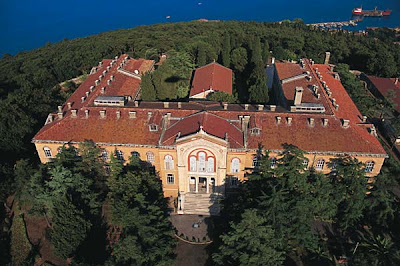
The closed Halki Theological Seminary, Heybeliada island, near Istanbul.

In their comprehensive fight against the Patriarchate, the Turks often point out to the fact that there is no longer a city called Constantinople. Therefore, they say, anyone with the title of 'Patriarch of Constantinople' is the Patriarch of a non- existent city and is redundant! The Turkish government also reputedly insists that any chosen Patriarch must be a Turkish born citizen. This requirement makes the Patriarchal succession matters very difficult, given the very small number of Greeks left in Turkey. On the other hand, Ankara surely realises that there are always limits to the restrictions and difficulties it can impose to such an historical and venerable institution. The backlash from excessive restriction can be unpredictable and strong.
The Turkish authorities also exert other types of direct pressure on the Patriarchate. The closure of the clerical Seminary of Halki is a good and known example. This important Seminary and theological school is situated on the island of Heybeliada. This beautiful Island is part of the Prince Islands. It is also is home to the Turkish Navy's Cadet Academy.

The Halki seminary and theological school is shut down since the 1971s, making the operations and survival of the Patriarchate even more painful. This is a rather cynical move designed to suffocate the Patriarchate at its base: A closed seminary means clergy shortage, which in turn implies very few new potential church leaders and therefore no qualified Turkish-born Greek Patriarch in the future for the throne. Therefore if the regulations are not changed, it will be very difficult to find a Turkish born Greek ascending to the Patriarchal throne, unless these series of restrictive rules are scrapped or modified by the government.

This ongoing thorny issue of Halki seminary's forced closure was recently raised in Turkey by the visiting president Barack Obama without immediate positive results. In 1999 president Clinton had personally visited the seminary, again urging for the immediate reopening of this very essential theological school. It is to be noted that Halki was initially closed on the grounds that according to the law, all higher educational schools and universities in Turkey must be part of State Universities system or be closed. This is another ''convenient'' law to further squeeze the minorities and their particular needs just to be able to survive.

My much anticipated visit to the Patriarchate went as planned. First, I visited the world famous St. Chora (Kariye camii) byzantine church and its incomparable mosaics. After a thirty minutes walk through the conservative Muslim neighbourhoods of Balat and Phanar (Fener), I noticed a street vendor selling hundreds of Christian Icons and modern day productions of Orthodox faith artifacts on a mobile cart. That was a sure sign I was very close to the Patriarchate! Where else street vendors would sell Greek Icons and Orthodox souvenirs?

The mandatory huge Turkish flag over the Patriarchate complex was disproportionate in size and a clear reminder that who is really in charge around. I entered the complex through the left side door of the main forged iron gate. The central portion of the main gate is shut 365 days per year and is unusable. Actually, they say it is welded in order to commemorate Patriarch Gregory V, who was deposed and hanged in that central gate of the Patriarchate when the Greek War of Independence broke out in 1821. Gregory V was charged for treason against the Ottoman Empire for siding with the Greeks in their revolt. He was hanged right there at the entrance of his Patriarchate. He was succeeded by Patriarch Eugenius II, who was himself a prisoner of the Ottomans at time of his election as the new Patriarch!

To the left stands the Patriarchal church St George, officially known as Holy Great Martyr Saint George Tropaioforos. The church is a basilica with three aisles. It is by no means very impressive but it does contain some original relics dating from the early days of the Byzantine church like the Throne of the Patriarch, the marble Synthronon marble throne behind the altar table, the very decorative historical Chanters’ stands and a very interesting elevated pulpit. Various icons of great importance and other beautiful relics fill the church.

During my short visit, the church was almost empty except for the hyperactive cleaning man, always suspiciously checking my movements while doing his work. The church and the adjoining buildings are not necessarily very impressive but are very well maintained, freshly painted clean and inviting. At the entrance of the church colour brochures about the Patriarchate are there for free distribution along with small yellow taper shaped candles. The pictures in the brochures are nice, the information is very selective and manicured not to offend anyone. The featured Patriarch Demetrius I, prominently on the cover of the booklet, is dead long time ago, in 1991. I guess this is why these very old and redundant brochures were free. The incumbent Patriarch is of course Bartholomew I. But who will succeed him? And how? Very open questions indeed...

During my visit I was practically alone in the church for a while, feeling the full weight of centuries of history in this uniquely important place. From Haghia Sofia to this modest church and into an unclear future, if only these walls could tell their story about all these centuries of hardship and daily struggle for survival.

After a while a few Russian tourists made their appearance and disturbed the peace with their noisy picture taking antics. I lit a candle, said a little prayer for all my loved ones and I headed back to the main gate with that famously welded central door. I left the Ecumenical Patriarchate and headed to the Golden Horn shore on my way back to picturesque and trendy Ortakoy by the Bosporus. I left the Patriarchate, but the very rich, tragic history and the mostly uncertain future of that Institution still fascinate and somehow haunt me.


© Krikor Tersakian 2009


The Ecumenical Patriarchate of Constantinople: A Story of Survival


The Haghia Yorgi (Ste Georges church) of the Ecumenical Patriarchate, Fener.


As far as I remember, I was always intrigued by the "Ecumenical" Patriarchate of the Orthodox Church based in Istanbul. So often I would read or hear on the news: ''The Ecumenical Patriarch Athenagoras today had a meeting with the Pope'' or ''Athenagoras today met with this or that president''.

But who is this enigmatic Patriarch and his Patriarchate? I would always ask. Questions puzzling me at my tender age... To make the matters even more complicated, the Armenian translation of the Patriarchate’s title contains the word ''Diyezeragan'', a vague translation of universal/ ecumenical/Cosmopolitan. hardly an easy job to describe!

Moreover, the Greek word ‘’Ecumenical’’ has always sounded a bit funny to me. The sight of an old and bearded Greek Patriarch residing in Istanbul where there are almost no Greeks left added to the puzzle. Therefore, visiting the Holy See of the Ecumenical Patriarchate was very exciting to me to learn and understand more.

Since the Byzantine Empire and the Ottoman conquerors, this original Orthodox Patriarchate has always been present. When Constantinople became the capital of the Eastern Roman Empire, a series of church councils and events elevated New Rome’s (Constantinople) Bishop to its current position of Patriarch. The Fourth Ecumenical council of Chalcedon in 451 A.D. confirmed the Patriarchate as only second in importance to the Bishop (Pope) of Rome. (Note:Chalcedon or today's Kadikoy is situated on the Asian side of the city. Kaghketon in Armenian).


The Great Schism, or the division of the Eastern Orthodox and Latin west in 1054 AD, established the Constantinople Patriarch as de facto leader of the Orthodox Church. Subsequently numerous pan-Orthodox meetings and synods were held under the auspices of the Ecumenical Patriarch. Naturally with the fall of the Byzantine Empire naturally the Patriarchate was greatly weakened remaining under Ottoman rule, and It was literally expelled from the Haghia Sofia by the Ottoman conquerors. The orphaned, unwanted and homeless Patriarchate then wandered from one host church to another for long decades. It finally established in its present location in 1599 AD, 146 years after the conquest. since that date the Church of Saint Georges and the adjacent Patriarchate buildings have since been the headquarters. They are located on a hill on the south shore of the Golden Horn (European side of the city) in the Fener (Phanar) district about 7 km west of Haghia Sofia and the Topkapi. The Phanar district at the time was mostly inhabited by non Turks, mostly Greeks and Jews, and was therefore a rather logical choice.

Despite of all these historical hardships and setbacks, the Ecumenical Patriarchate has always managed to hold on to a great prestige, some real power and considerable moral authority in the Christian church worldwide. After the Ottoman conquest, naturally the Patriarchate lost more and more power and authority to other arising and independent minded rival Patriarchates such as Athens and Moscow. Much maligned, sometimes ridiculed and weakened, but the Ecumenical Patriarchate is still respected as the ''First among equals'', a brilliant formula in order to preserve a semblance of ''peace'' among all the rival Orthodox Patriarchates and their flocks. The relationship with the emerging rival Patriarchates in the Orthodox world has not been easy, but nobody seriously questions Ecumenical Patriarchate's moral authority which is deeply anchored in history and geography.


Pope Benedict XVI, left, and Ecumenical Patriarch Bartholomew I at the Ecumenical Patriarchate at the Patriarchate in Istanbul, Turkey, Thursday, Nov. 30, 2006. The Greek ''East'' meets the Latin "West''.


On the other hand, the relationship of the Patriarchate with the successive Turkish governments has also been consistently tense throughout the ages. It is to be noted that the Turkish authorities recognise the Patriarchate by the minimalist "Patriarchate of Phanar" title, sounding like a mere ''neighbourhood'' institution and not much more. The Turkish government officially does not recognize the wider importance of the Patriarchate, nor does it recognise any of its supposed jurisdictions outside its limited and local territory. The Patriarchate is considered an authority over the very small flock of around 2500 Greeks residing in Istanbul, that is not much more than a simple "Milletbashi", the spiritual leader of a local millet (nation or ethnic group).


The Theological college near the Patriarchate in Fener, Istanbul.


A few decades back the number of Greeks (known as Rum) was well over 150,000. The last wave left when Turkish nationalist mobs attacked, burned and looted hundreds of Greek and other minorities owned businesses, mainly in the Beyoglu-Pera district in September 1956. These sad events are known as the Istanbul Pogroms and were caused by a false accusation of a supposed bombing of Ataturk's birth place house in Thessaloniki, Greece. The Greek community was devastated by these concerted and pre-organised attacks and it never recovered. These barbaric destruction and looting against the Greek community were act of aggression which finally broke the camel's back. Within 20 years after that bloody chapter, the number of Greeks residing in Istanbul had shrunk to a couple of thousands. The rest fled under the constant discrimination and persecution. Nowadays it is jokingly said that "it is easier to find a Giraffe in Paris than a Greek in Istanbul!"
The closed Halki Theological Seminary, Heybeliada island, near Istanbul.

In their comprehensive fight against the Patriarchate, the Turks often point out to the fact that there is no longer a city called Constantinople. Therefore, they say, anyone with the title of 'Patriarch of Constantinople' is the Patriarch of a non- existent city and is redundant! The Turkish government also reputedly insists that any chosen Patriarch must be a Turkish born citizen. This requirement makes the Patriarchal succession matters very difficult, given the very small number of Greeks left in Turkey. On the other hand, Ankara surely realises that there are always limits to the restrictions and difficulties it can impose to such an historical and venerable institution. The backlash from excessive restriction can be unpredictable and strong.
The Turkish authorities also exert other types of direct pressure on the Patriarchate. The closure of the clerical Seminary of Halki is a good and known example. This important Seminary and theological school is situated on the island of Heybeliada. This beautiful Island is part of the Prince Islands. It is also is home to the Turkish Navy's Cadet Academy.

The Halki seminary and theological school is shut down since the 1971s, making the operations and survival of the Patriarchate even more painful. This is a rather cynical move designed to suffocate the Patriarchate at its base: A closed seminary means clergy shortage, which in turn implies very few new potential church leaders and therefore no qualified Turkish-born Greek Patriarch in the future for the throne. Therefore if the regulations are not changed, it will be very difficult to find a Turkish born Greek ascending to the Patriarchal throne, unless these series of restrictive rules are scrapped or modified by the government.

This ongoing thorny issue of Halki seminary's forced closure was recently raised in Turkey by the visiting president Barack Obama without immediate positive results. In 1999 president Clinton had personally visited the seminary, again urging for the immediate reopening of this very essential theological school. It is to be noted that Halki was initially closed on the grounds that according to the law, all higher educational schools and universities in Turkey must be part of State Universities system or be closed. This is another ''convenient'' law to further squeeze the minorities and their particular needs just to be able to survive.

My much anticipated visit to the Patriarchate went as planned. First, I visited the world famous St. Chora (Kariye camii) byzantine church and its incomparable mosaics. After a thirty minutes walk through the conservative Muslim neighbourhoods of Balat and Phanar (Fener), I noticed a street vendor selling hundreds of Christian Icons and modern day productions of Orthodox faith artifacts on a mobile cart. That was a sure sign I was very close to the Patriarchate! Where else street vendors would sell Greek Icons and Orthodox souvenirs?

The mandatory huge Turkish flag over the Patriarchate complex was disproportionate in size and a clear reminder that who is really in charge around. I entered the complex through the left side door of the main forged iron gate. The central portion of the main gate is shut 365 days per year and is unusable. Actually, they say it is welded in order to commemorate Patriarch Gregory V, who was deposed and hanged in that central gate of the Patriarchate when the Greek War of Independence broke out in 1821. Gregory V was charged for treason against the Ottoman Empire for siding with the Greeks in their revolt. He was hanged right there at the entrance of his Patriarchate. He was succeeded by Patriarch Eugenius II, who was himself a prisoner of the Ottomans at time of his election as the new Patriarch!

To the left stands the Patriarchal church St George, officially known as Holy Great Martyr Saint George Tropaioforos. The church is a basilica with three aisles. It is by no means very impressive but it does contain some original relics dating from the early days of the Byzantine church like the Throne of the Patriarch, the marble Synthronon marble throne behind the altar table, the very decorative historical Chanters’ stands and a very interesting elevated pulpit. Various icons of great importance and other beautiful relics fill the church.

During my short visit, the church was almost empty except for the hyperactive cleaning man, always suspiciously checking my movements while doing his work. The church and the adjoining buildings are not necessarily very impressive but are very well maintained, freshly painted clean and inviting. At the entrance of the church colour brochures about the Patriarchate are there for free distribution along with small yellow taper shaped candles. The pictures in the brochures are nice, the information is very selective and manicured not to offend anyone. The featured Patriarch Demetrius I, prominently on the cover of the booklet, is dead long time ago, in 1991. I guess this is why these very old and redundant brochures were free. The incumbent Patriarch is of course Bartholomew I. But who will succeed him? And how? Very open questions indeed...

During my visit I was practically alone in the church for a while, feeling the full weight of centuries of history in this uniquely important place. From Haghia Sofia to this modest church and into an unclear future, if only these walls could tell their story about all these centuries of hardship and daily struggle for survival.

After a while a few Russian tourists made their appearance and disturbed the peace with their noisy picture taking antics. I lit a candle, said a little prayer for all my loved ones and I headed back to the main gate with that famously welded central door. I left the Ecumenical Patriarchate and headed to the Golden Horn shore on my way back to picturesque and trendy Ortakoy by the Bosporus. I left the Patriarchate, but the very rich, tragic history and the mostly uncertain future of that Institution still fascinate and somehow haunt me.
© Krikor Tersakian, Montreal, Canada